
The Most Common Mistakes When Pulling Ethernet Cable (And How to Avoid Them)
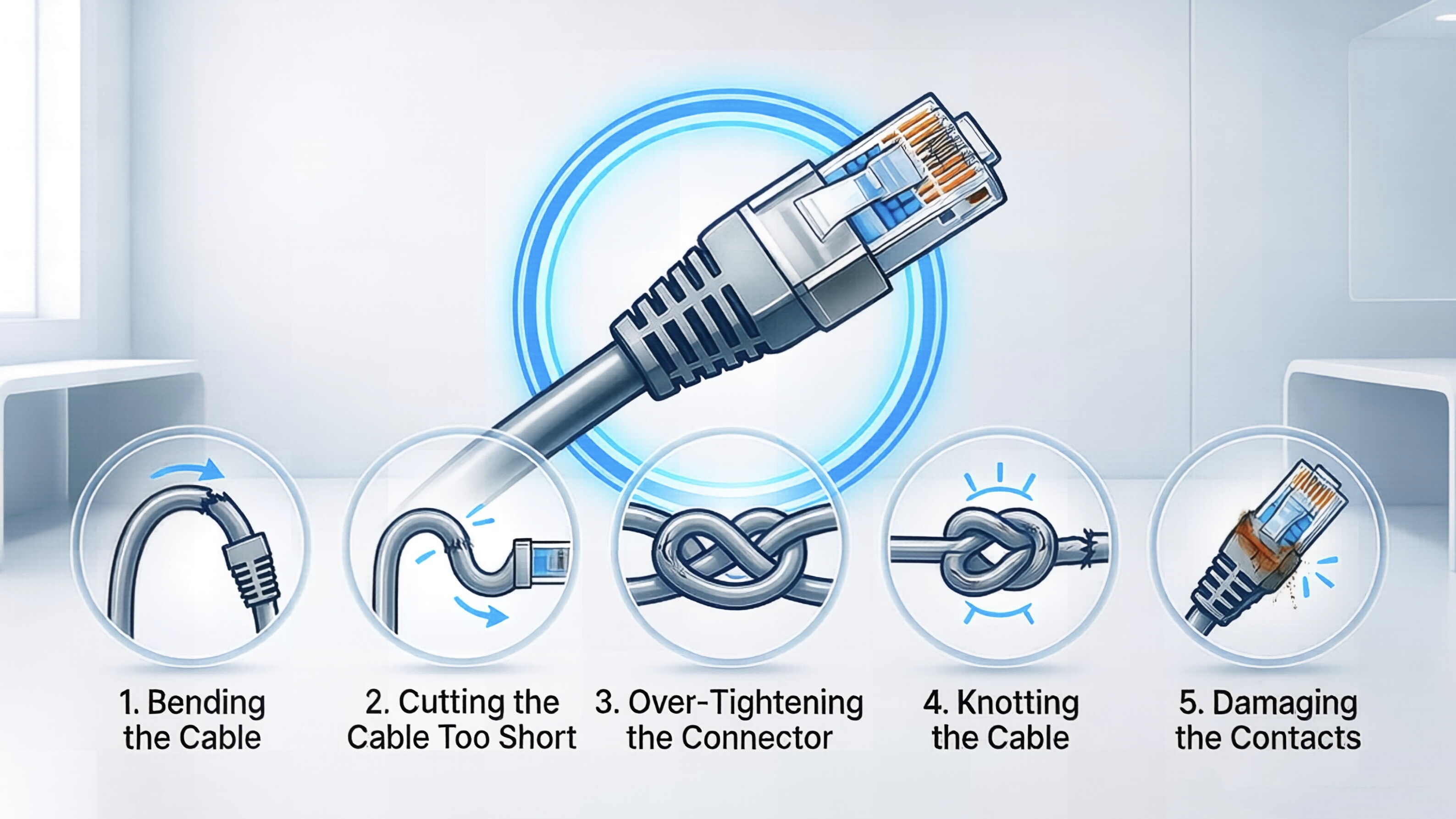
The Most Common Mistakes When Pulling Ethernet Cable (And How to Avoid Them)
April 14, 2026
Even experienced installers can make mistakes when pulling Ethernet cable. A seemingly minor error can turn a perfect cable into a source of intermittent failures, low speeds, or failed certification. The good news: most of these mistakes are easy to avoid once you know what to look for.
In this guide, we cover the most common pulling mistakes and show you the right way to do it—so your network performs as designed, project after project.
Small mistakes during pulling can cause big problems later. Here's how to get it right.
1. Pulling Too Hard (Exceeding Tensile Load)
The mistake: Yanking the cable with brute force, especially around corners or through tight conduits. Many installers think “stronger pull = faster job.”
Why it's bad: Excessive tension stretches the copper conductors, changes their impedance, and can break the twisted pairs. The result: signal reflections, high return loss, and failed Fluke tests—even if the cable looks fine.
How to avoid it: Use a pulling grip or mesh sock. For longer runs, use a pulling lubricant (cable lube). Never exceed the manufacturer’s rated tensile load (typically 110N or 25 lbs for Cat5e/6). If it feels hard, stop and check for obstructions.
2. Bending Too Sharp (Violating Bend Radius)
The mistake: Bending the cable into a tight corner, kinking it, or flattening it against a sharp edge.
Why it's bad: A bend that's too sharp causes the twisted pairs to deform, creating signal reflections and excessive attenuation. Once the cable is kinked, the damage is permanent.
How to avoid it: Follow the 4x rule: the bend radius should be at least 4 times the cable diameter (e.g., for a 6mm cable, minimum bend radius is 24mm). During pulling, use gradual sweeps instead of 90° elbows if possible. For patch cords, never bend tighter than 1 inch (25mm) radius.
3. Pulling Without a Cable Lubricant in Conduit
The mistake: Dry-pulling cable through long or crowded conduit, especially with existing wires.
Why it's bad: Friction heats up the cable jacket, can strip insulation, and increases pulling tension—leading to the problems above. It also damages the jacket surface, making it prone to future cracking.
How to avoid it: Use a water-based, non-staining cable lubricant. Apply it as you feed the cable. For very long runs (over 50m), reapply lubricant at intermediate pull points.
4. Pulling by the Cable Sheath Instead of the Pulling Grip
The mistake: Attaching the pulling rope or fish tape directly to the cable jacket using a knot or tape.
Why it's bad: The pulling force is concentrated on the jacket and conductors, not distributed. This can stretch the twisted pairs inside even if the jacket seems fine.
How to avoid it: Always use a pulling grip (mesh basket) or a pulling eye that attaches to the conductors themselves (for multi-pair). If you must use tape, use a “cable pulling sock” or a “pull loop” that cinches around the jacket evenly.
5. Not Untwisting the Pair Too Much (But Also Too Little)
The mistake: Untwisting the pairs more than 13mm (0.5 inch) when terminating after pulling—or leaving them completely twisted and forcing the connector.
Why it's bad: Excessive untwisting destroys the cable's crosstalk cancellation. Too little untwisting prevents the pairs from seating properly in the connector.
How to avoid it: The TIA standard says no more than 13mm of untwist at termination. Practice making a clean cut, arrange the pairs, and keep the twist as close to the punchdown or plug as possible.
6. Using Zip Ties Too Tight
The mistake: Cinching zip ties around cable bundles until they dig into the jacket.
Why it's bad: Over-tight zip ties crush the cable, deforming the internal pairs and changing the impedance. It can also damage the jacket, exposing conductors to moisture later.
How to avoid it: Use hook-and-loop (Velcro) straps instead of zip ties. If you must use zip ties, leave them loose enough that you can rotate the bundle inside. Never tighten with pliers.
7. Mixing Different Cable Categories in the Same Pull
The mistake: Pulling Cat5e and Cat6 together in the same bundle or conduit without separation.
Why it's bad: Higher-category cables (Cat6) can induce alien crosstalk into lower-category cables (Cat5e) when run tightly together for long distances. This degrades performance of both.
How to avoid it: Separate cables by category when possible. If they must share a conduit, use a divider or keep a small gap. For Cat6A, always separate from Cat5e/Cat6 to preserve alien crosstalk margins.
Quick Reference: Do's and Don'ts
| Mistake | Don't | Do |
|---|---|---|
| Pulling force | Yank hard or exceed 110N | Use pulling grip + lubricant |
| Bend radius | Kink or bend sharply | Keep 4x diameter minimum |
| Conduit friction | Dry pull long runs | Use cable lubricant |
| Attachment | Tie knot in cable jacket | Use pulling mesh sock |
| Zip ties | Cinch tight | Use Velcro or loose ties |
Final Tip: Always Test After Pulling
Even if you follow all these rules, cable can be damaged internally without visible signs. After pulling and terminating, test each link with a continuity tester or, better, a Fluke Certifier. A few minutes of testing can save hours of troubleshooting later.
Your Partner in Quality Cabling
At Shenzhen Xunyu Cable Technology Co.,ltd., we manufacture Ethernet cables that are easy to pull and terminate—with consistent 23AWG pure copper conductors and flexible jackets. Our cables are built to handle proper installation without hidden defects.
Have questions about installation or need a reliable cable supplier? Contact us for advice or a quote. We're here to help your projects succeed.
WhatsApp / WeChat:+86 18925240250
Published on April 14, 2026 – Practical tips for better network installations.