
Wi-Fi 7 and the Cabling Backbone: Why Cat6/Cat6A Is Non‑Negotiable
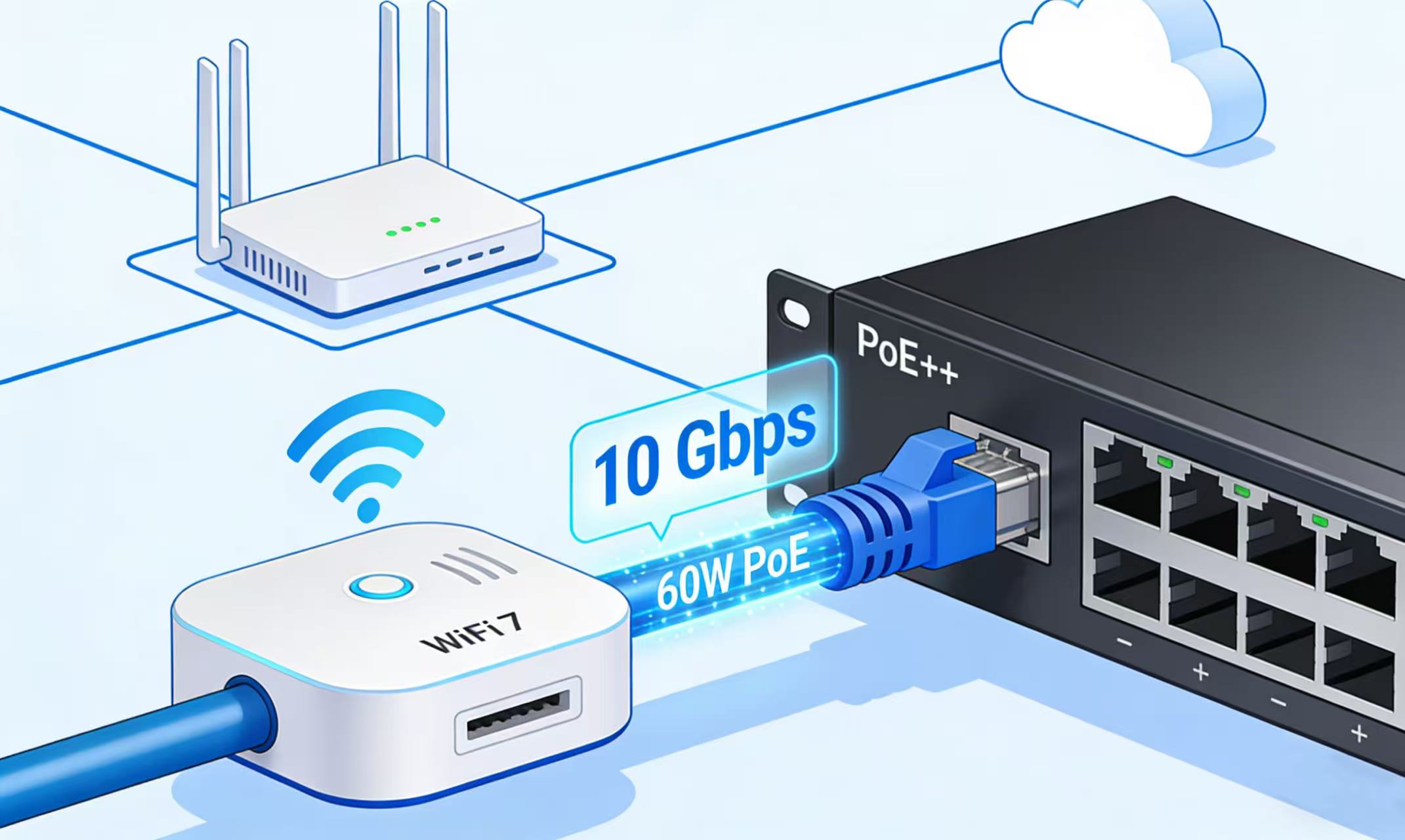
Wi-Fi 7 and the Backbone: Why Wired Infrastructure Still Matters
With Wi-Fi 7 (802.11be) rolling out across enterprises and smart buildings, the wireless industry is making bold promises: multi‑gigabit speeds, ultra‑low latency, and the capacity to support hundreds of connected devices. It's easy to assume that cables will soon become obsolete. But the reality is quite the opposite.
Wi-Fi 7's breakthrough performance doesn't eliminate the need for cabling—it makes it more critical than ever. For B2B buyers—distributors, integrators, and network planners—understanding this relationship is key to designing reliable, future‑ready networks.
How Wi‑Fi 7 Changes the Game
Wi‑Fi 7 introduces several major improvements over Wi‑Fi 6/6E:
- 320 MHz channels – double the bandwidth of Wi‑Fi 6
- 16 spatial streams – more simultaneous connections
- Multi‑Link Operation (MLO) – aggregated throughput across bands
- Theoretical speeds up to 46 Gbps – but only if the wired backhaul can support it
These advances are impressive, but they shift the bottleneck from the air to the wire. A Wi‑Fi 7 access point (AP) is only as fast as the Ethernet cable that feeds it.
The Wired Backbone: Why It’s Non‑Negotiable
Every Wi‑Fi 7 access point requires a physical connection to the network. Wireless is simply the last hop. The backbone—the cabling that connects APs to switches, switches to servers, and servers to the internet—must handle the aggregated traffic of dozens or hundreds of wireless clients.
Here's why the wired infrastructure remains indispensable:
1. Speed and Capacity
Wi‑Fi 7 APs typically include 2.5GbE, 5GbE, or even 10GbE uplink ports. If the cabling is Cat5e (limited to 1 Gbps), the AP becomes a bottleneck. To realize multi‑gigabit wireless, you need Cat6 or Cat6A cabling that can carry 2.5/5/10 Gbps over the full 100‑meter channel.
2. Power over Ethernet (PoE)
Wi‑Fi 7 APs are power‑hungry. Many require PoE+ (802.3at, up to 30W) or PoE++ (802.3bt, up to 60W or 100W) to operate all radios and features. Power delivery relies on the cable's conductor gauge and quality. Pure copper conductors (vs. copper‑clad aluminum) are essential to safely deliver higher power without overheating or voltage drop.
3. Reliability and Determinism
Wireless is subject to interference, congestion, and signal fading. The wired backbone provides a deterministic, interference‑free path. For mission‑critical applications—healthcare, industrial automation, financial trading—the reliability of a cabled connection is irreplaceable.
4. Future‑Proofing
Wi‑Fi standards evolve every few years, but cabling infrastructure typically lasts 10–15 years. Installing higher‑grade cabling today (Cat6A or higher) ensures the backbone can support multiple generations of wireless upgrades without costly rewiring.
What This Means for Your Network Design
For system integrators and network planners, the rise of Wi‑Fi 7 reinforces the importance of specifying the right cabling. Consider these guidelines:
| Wi‑Fi Generation | Recommended Cabling | Why |
|---|---|---|
| Wi‑Fi 5 / 6 | Cat5e or Cat6 | 1 Gbps uplinks; PoE+ up to 30W |
| Wi‑Fi 6E / 7 | Cat6 (2.5/5 Gbps) or Cat6A (10 Gbps) | Multi‑gig uplinks; PoE++ up to 60W+; future‑proof |
| Future Wi‑Fi (8+) | Cat6A or higher (fiber for long runs) | 10 Gbps+ backhaul; higher power requirements |
Debunking the “Wireless Everything” Myth
Some assume that as wireless speeds increase, wired connections will disappear. In reality, wireless densification drives more cabling, not less. Each new AP requires a dedicated cable run. High‑density venues (stadiums, airports, campuses) often deploy hundreds or thousands of APs, each with its own PoE‑enabled cable.
Furthermore, many devices—desktops, servers, security cameras, IoT sensors—remain wired for reliability and security. The network is a hybrid, and the wired foundation supports everything above it.
Your Partner in Future‑Ready Cabling
At Shenzhen Xunyu Cable Technology Co.,ltd., we manufacture high‑performance Ethernet cables designed to support today's Wi‑Fi 7 deployments and tomorrow's innovations.
Whether you need Cat6 for 2.5/5 Gbps backhaul or Cat6A for full 10 Gbps and PoE++ capability, we provide the reliability your network demands.
Ready to build a wireless network on a solid wired foundation? Contact our team for technical guidance, product samples, or bulk pricing. Let's ensure your infrastructure is ready for Wi‑Fi 7 and beyond.
WhatsApp / WeChat:+86 18925240250
Published on March 27, 2026 – Wired for wireless success.