Fiber Optical Cable: The Core Solution for High-Speed and Stable Network Transmission
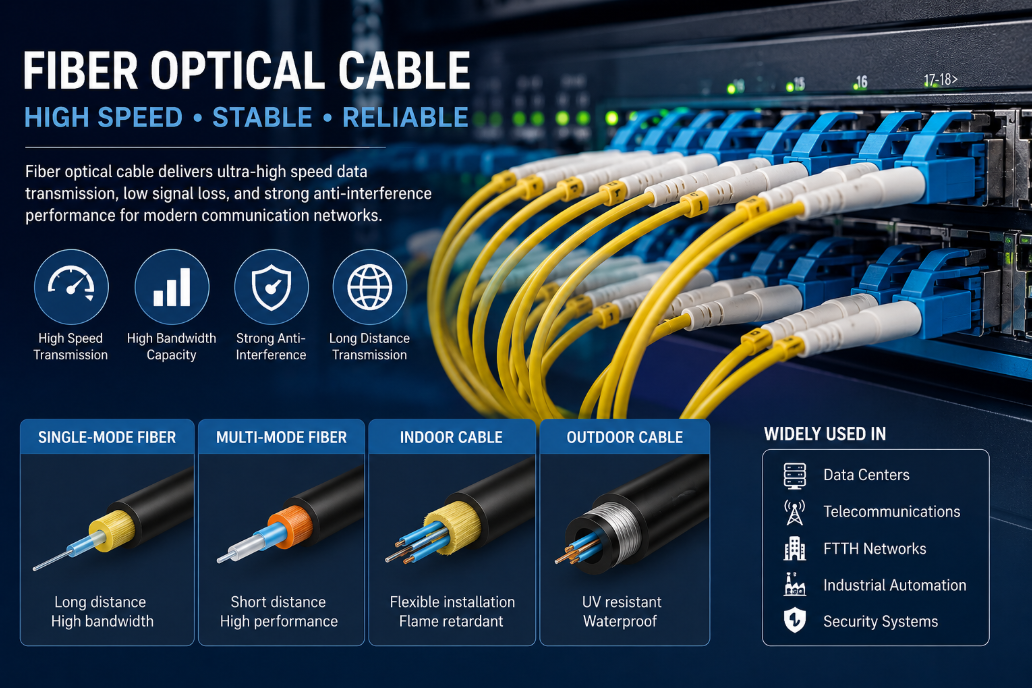
In today’s digital world, high-speed communication and stable data transmission are more important than ever. From data centers and enterprise networks to smart cities and 5G infrastructure, Fiber Optical Cable has become the backbone of modern communication systems. Compared with traditional copper cables, fiber optic cables provide faster transmission speeds, higher bandwidth capacity, lower signal loss, and stronger resistance to electromagnetic interference.
As global demand for cloud computing, video streaming, industrial automation, and IoT devices continues to grow, businesses and network providers are increasingly choosing fiber optical cable solutions to improve network performance and long-term reliability.
This article explains the advantages of fiber optical cable, its key structure and specifications, common applications, installation recommendations, and why high-quality fiber optic solutions are essential for modern communication systems.
1. What Is Fiber Optical Cable?
Fiber Optical Cable is a communication cable that uses optical fibers to transmit data signals through light instead of electrical currents. Optical fibers are typically made of ultra-pure glass or plastic materials that allow light signals to travel over long distances with minimal attenuation.
A standard fiber optical cable mainly consists of:
- Optical fiber core
- Cladding layer
- Protective coating
- Strength member
- Outer jacket
The fiber core carries light signals, while the cladding reflects the light back into the core to maintain signal integrity.
Fiber optic cables are generally divided into two major categories:
Single-Mode Fiber Cable
Single-mode fiber is designed for long-distance transmission with extremely high bandwidth capacity. It is commonly used in:
- Telecommunications
- Metropolitan area networks
- Data centers
- 5G backbone infrastructure
Multi-Mode Fiber Cable
Multi-mode fiber is ideal for shorter-distance applications with high-speed data transmission requirements, including:
- Office networks
- Local area networks (LAN)
- Security systems
- Indoor communication systems
Both types of fiber optical cable provide stable and efficient data transmission for modern networking environments.
2. Advantages of Fiber Optical Cable
Compared with traditional copper networking cables, fiber optical cables offer several significant advantages.
Ultra-High Transmission Speed
Fiber optic cables support much higher bandwidth than copper cables, making them ideal for high-speed internet, cloud services, and large-scale data transmission.
Modern fiber networks can support:
- Gigabit Ethernet
- 10G/40G/100G data transmission
- Ultra-HD video streaming
- Real-time cloud computing
Low Signal Loss
One of the biggest advantages of fiber optical cable is low attenuation over long distances.
This allows stable communication across:
- Long-distance outdoor installations
- Telecommunications networks
- Industrial communication systems
Fiber cables can transmit signals over kilometers without requiring frequent signal boosters.
Strong Anti-Interference Performance
Unlike copper cables, fiber optical cables are immune to electromagnetic interference (EMI) and radio frequency interference (RFI).
This makes them suitable for:
- Industrial environments
- Medical equipment systems
- High-voltage areas
- Smart factory automation
Stable signal transmission improves overall network reliability and equipment safety.
Enhanced Security
Fiber optic cables are extremely difficult to tap or intercept without detection, making them a preferred choice for secure communication systems and enterprise networks.
3. Common Applications of Fiber Optical Cable
Fiber optical cable is widely used across multiple industries and communication infrastructures.
Data Centers
Modern data centers rely heavily on fiber optic networks to support:
- High-speed server communication
- Cloud computing
- Big data processing
- AI infrastructure
Fiber cables provide the bandwidth and low latency required for continuous data transmission.
Telecommunications and 5G Networks
Telecom providers use fiber optical cable as the backbone of modern communication systems.
Applications include:
- FTTH (Fiber to the Home)
- 5G base station connections
- Broadband internet services
- Long-distance communication networks
Smart Buildings and Security Systems
Fiber optic cables are increasingly used in:
- CCTV surveillance systems
- Intelligent building management
- Access control systems
- Smart city infrastructure
Their stable performance helps improve system efficiency and reliability.
Industrial Automation
Industrial fiber optic networks provide stable communication in harsh environments where electromagnetic interference may affect traditional cables.
Common industrial applications include:
- Factory automation
- Robotics
- Power plants
- Transportation systems
4. Installation and Maintenance Recommendations
Proper installation and maintenance are essential for maximizing fiber optical cable performance.
Avoid Excessive Bending
Optical fibers are sensitive to excessive bending. Tight bends may cause signal loss or permanent fiber damage.
Always follow the recommended bending radius during installation.
Use Proper Protective Conduits
Outdoor and underground installations should use protective conduits to prevent:
- Physical damage
- Moisture intrusion
- Rodent damage
- Environmental wear
Keep Connectors Clean
Dust and contamination on fiber connectors can reduce signal quality.
Regular cleaning helps maintain optimal network performance and reduces transmission errors.
Choose Certified High-Quality Fiber Cables
Selecting fiber optical cables that comply with international standards ensures better durability and performance.
Recommended certifications include:
- ISO
- RoHS
- CE
- UL
High-quality fiber cables provide longer service life and lower maintenance costs.
5. Conclusion: Fiber Optical Cable Is the Future of High-Speed Communication
As network demand continues to increase worldwide, Fiber Optical Cable has become the preferred solution for modern communication infrastructure. Its high-speed transmission capability, low signal loss, strong anti-interference performance, and superior reliability make it essential for data centers, telecommunications, industrial automation, and smart network systems.
When selecting fiber optical cable products, users should consider:
- Transmission distance
- Bandwidth requirements
- Installation environment
- Fiber type
- Cable protection level
High-quality fiber optic cable solutions not only improve network efficiency but also help businesses build more stable, scalable, and future-ready communication
systems.
Shenzhen Xunyu Cable Technology Co., Ltd.
Specializing in the production of various high-quality cables, our main products include network cables (Cat5e, Cat6, Cat7), coaxial cables, speaker cables, power cables, patch cords, and more, with OEM customization available.
For product selection guidance or sample testing, please feel free to contact us.
WhatsApp / WeChat:+86 18925240250
How Power Cable Specifications Affect Equipment Safety
Related Article