How to Choose the Right Ethernet Cable Type for Your Business Network?

1.The Importance of Enterprise Network Infrastructure
In the 2025 business environment, enterprise networks are no longer just "logistics support" — they have become a core infrastructure that directly determines productivity, data security, and even customer experience. According to the latest Gartner research, unplanned downtime caused by enterprise network failures costs an average of over $5,000 per hour, and more than 40% of the root causes lie hidden inside the walls — in the Ethernet cables.
Many business owners tend to focus their budgets on "visible" equipment such as servers and switches when renovating or expanding, overlooking the fact that the cabling system is the cornerstone of the physical layer. If enterprise network cable selection is done incorrectly, minor issues like packet loss and choppy video conferences can occur, while severe problems may lead to ERP disconnections and production data synchronization failures. Therefore, making the right choice in enterprise network cable selection is the first and most underestimated step in digital transformation.
2.Performance and Price Comparison of Different Network Cables
Currently, the mainstream copper twisted-pair cables on the market fall into three main categories: Cat5e, Cat6, and Cat7. Their performance parameters and price differences vary significantly, directly impacting the cost-effectiveness of the overall solution.
It is important to note that while Cat5e is the cheapest, it has poor immunity to crosstalk and often results in "gigabit ports running at only 100 Mbps" in dense cabling environments. Cat6 strikes the best balance between cost and control — its internal cross separator effectively isolates the four pairs of conductors, greatly reducing near-end crosstalk. Cat7, with its full shielding and higher frequency support, can stably carry 10-gigabit traffic, but it requires highly professional installation and proper grounding.
3.Usage Environment Analysis: Small Office, Medium Enterprise, Large Enterprise
Different business sizes and workloads lead to completely different cabling strategies.
Small Office (10–30 people): These scenarios typically do not have a dedicated server room; routers or switches are placed directly in the office area. A full Cat6 unshielded cabling system is recommended. Why? Although Cat5e is cheaper, it will become a bottleneck in the next 2–3 years as 2.5 Gigabit LAN becomes more common. The extra cost of Cat6 is less than $3 per workstation, but it ensures the network will not fall behind for the next five years.
Medium Enterprise (30–150 people): Such organizations usually have a dedicated telecom room and multiple cascading switches. A hybrid cabling approach is recommended: use Cat6 shielded cables for the horizontal subsystem (from telecom room to wall outlets), but Cat7 must be used for the vertical backbone (from telecom room to core server room). In medium enterprises, concurrent traffic from video conferencing, file servers, and IP phones is high — Cat7’s strong interference rejection significantly reduces retransmissions and improves actual throughput.
Large Enterprise / Industrial Park (150+ people): In these environments, there are many sources of electromagnetic interference (elevators, HVAC, VFDs), and data traffic patterns are complex. A full Cat7 or higher shielded system with professional grounded patch panels is strongly recommended. Additionally, the backbone from each floor's telecom room to the core server room should reserve fiber optics, with copper cables only used for the last 100 meters of access. Only Cat7-grade shielding can ensure stable operation of latency-sensitive applications (real-time databases, VoIP) in large enterprises under high concurrency.
4.Purchasing and Cabling Practical Advice
Correct selection is only the first step; wrong purchasing and installation can still ruin the entire network. Here are four proven practical tips:
Avoid CCA (Copper-Clad Aluminum): Many low-cost “Cat6” cables on the market are actually CCA, which has high resistance and heats up easily. When used for PoE power delivery, they pose a fire hazard. Always buy bare solid copper cables. You can identify them by scratching the conductor — silver-white indicates aluminum, while reddish copper indicates real copper.
Flame and Bend Test: High-quality cable jackets should be flame-retardant (LSZH or CM rated). When lit with a lighter, they should stop burning as soon as the flame is removed. Also, bend the cable 180 degrees — a good copper core will not break.
Leave Sufficient Redundancy: Cable fill ratio inside metal conduits or PVC raceways should not exceed 50%. Leave 3–5 meters of service loop coiled at the telecom room end for each cable, making future re-termination or future upgrades easier.
Must Use Professional Test Equipment: Do not just test for continuity! Rent or hire a team with a Fluke DSX cable analyzer (or equivalent) to verify Near-End Crosstalk (NEXT), Return Loss (RL), and length attenuation. Only by passing these metrics will your Cat6 or Cat7 cables truly deliver their rated performance.
5.Summary: Cost-Effectiveness and Future Upgrades
Back to the core question: How to choose the right Ethernet cable type for your business network? The answer is: look at total cost of ownership, not initial material cost.
For maximum cost-effectiveness and no 10G needs within 3 years: Cat6 is the best answer. It is less than twice the price of Cat5e, but its performance and reliability are far superior.
For future-proofing over 5–8 years or when operating in high-interference environments: Go directly to Cat7. Although the per-meter cost is higher, it avoids the future expenses of breaking walls, re-cabling, and business interruption losses.
One more reminder: No matter which category you choose, make sure patch panels, jacks, patch cords, and bulk cables are all of the same category. A Cat7 cable terminated with a Cat5e connector will perform no better than Cat5e.
Remember: Enterprise network cable selection is not a one-time expense, but a long-term investment. Every replacement of in-wall cabling means drilling, dust, and downtime. The wise approach is — within budget, choose one grade higher than you think you need. Spend a little more today, save tens of thousands tomorrow.
Shenzhen Xunyu Cable Technology Co., Ltd.
Specializing in the production of various high-quality cables, our main products include network cables (Cat5e, Cat6, Cat7), coaxial cables, speaker cables, power cables, patch cords, and more, with OEM customization available.
For product selection guidance or sample testing, please feel free to contact us.
WhatsApp / WeChat:+86 18925240250
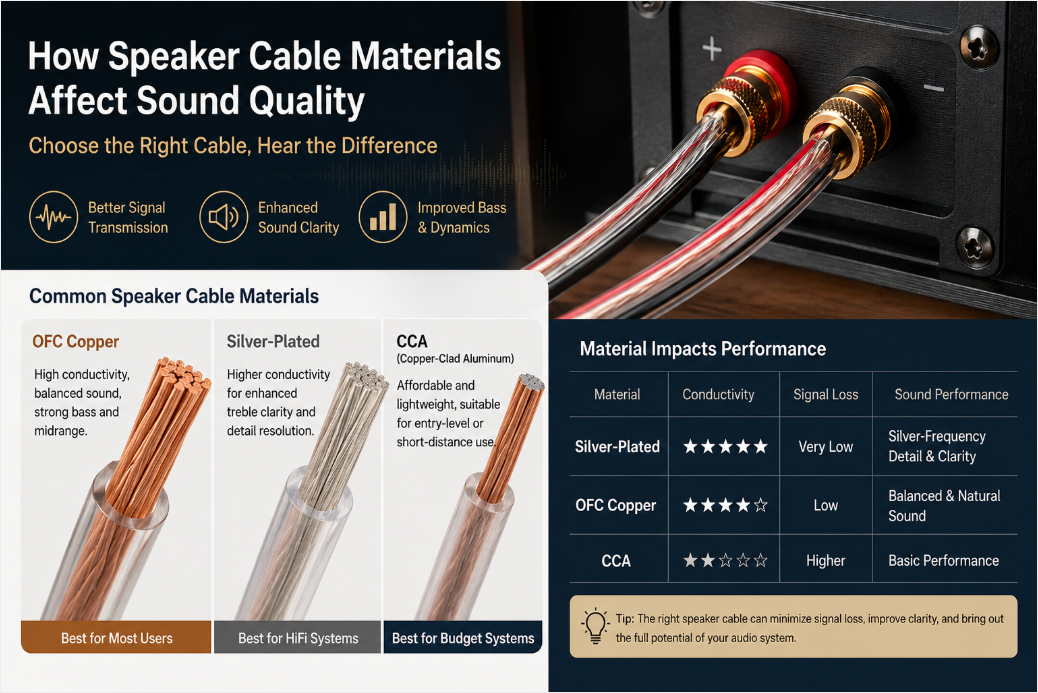
How Speaker Cable Materials Affect Sound Quality: Choosing the Right Cable for Better Audio Performance
How Cat7 Shielding Technology Improves Network Transmission Stability
Related Article