
Cable Color Management: Enhance Office Cabling Tidiness & Maintenance Efficiency
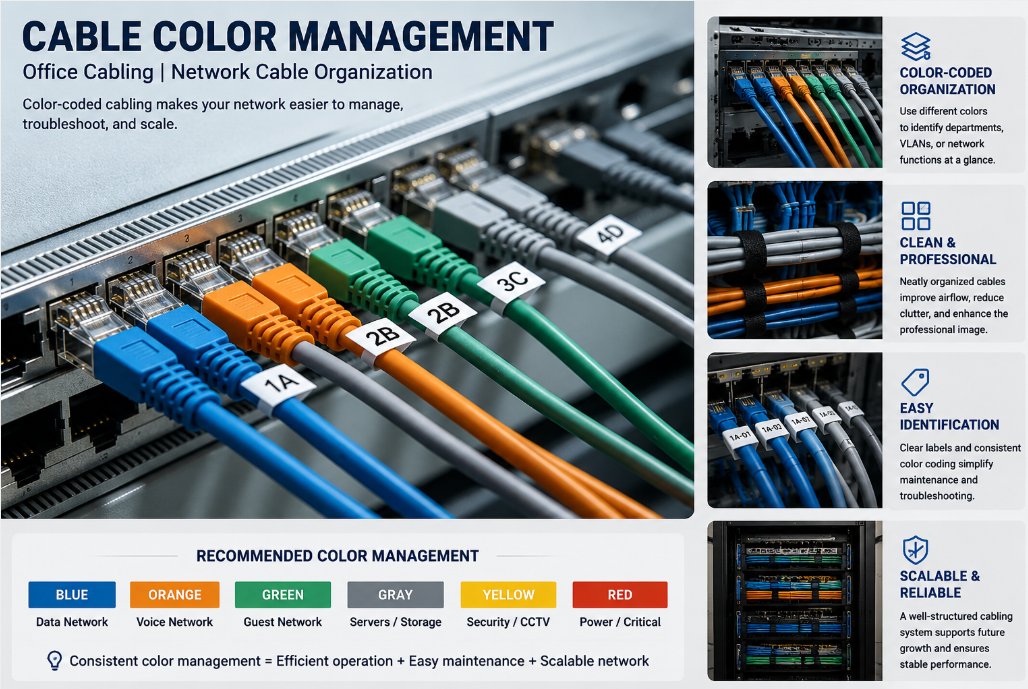
In today's digital workplace, stable and tidy network cabling is essential for business continuity. However, as devices multiply, workstations expand, and network structures grow more complex, office cabling has become a persistent headache for many IT teams. When a failure occurs, troubleshooting among dozens or even hundreds of identical-looking cables is often time-consuming and frustrating.
Cable color management is emerging as a highly effective, low-cost solution. By assigning different cable colors to different purposes, zones, or network types, companies can significantly improve cabling tidiness and dramatically reduce daily maintenance difficulty.
1. Three Major Challenges of Office Network Cabling
Most office network cabling faces the following common problems:
Cables are hard to identify: A tangle of mostly gray or blue cables makes it impossible to quickly trace routes or purposes.
Inefficient troubleshooting: Without clear mapping between switches, patch panels, and workstations, engineers must repeatedly "trace cables" during failures.
High cost of future changes: When personnel move or workstations are rearranged, reorganizing, removing, or adding cables often creates secondary chaos.
These issues not only harm the office environment but also directly increase IT maintenance time and introduce network outage risks.
2. Cable Color Classification & Management Methods
Implementing cable color management is straightforward. Companies can establish a simple, consistent color standard based on their network architecture. A common approach is as follows:
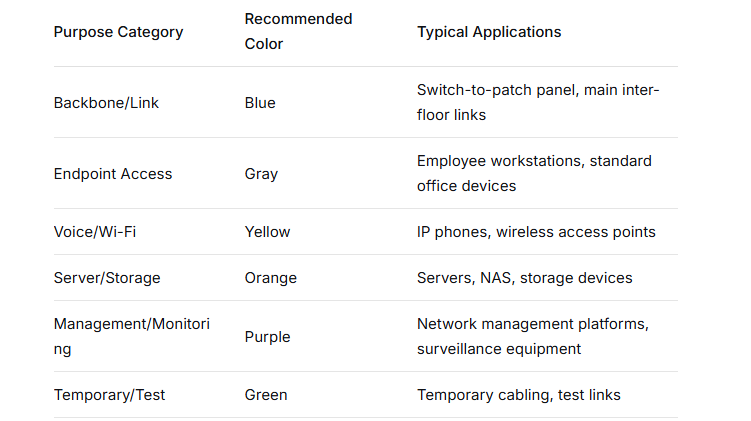
Once the color scheme is defined, it should be clearly documented at the patch panel, in the server room, and in the IT maintenance handbook.
3. Improving Efficiency & Maintenance Convenience
With color management, IT teams can identify cables at a glance — no tools, no need to consult records. The benefits include:
Fault location time reduced by more than 50% – narrow down suspicious cables immediately by color
Faster onboarding for new technicians – visual routing is far more intuitive
Cleaner server rooms and telco closets – fewer accidental disconnections or misplugs
Enhanced synergy with labeling – color + label creates a dual identification system
4.Real-World Case Study
During a 2025 office network upgrade, a mid-sized technology company fully adopted cable color management:
Backbone links used blue cables to clearly identify inter-floor and core-switch connections
Employee workstations used gray cables, uniformly connected to desk switches
Wireless APs and access control systems used yellow cables for easy identification in the telco closet
In one subsequent network outage, the IT engineer traced the root cause — a non-critical terminal connected via a gray cable — in just 6 minutes. Before the color-coded system, a similar issue would have taken an average of 25 minutes. Meanwhile, the company's telco closet cleanliness score rose from 2.8 to 4.7 out of 5.
5. Conclusion & Best Practices
Cable color management is not a complex networking project — it is a low-cost, high-return standardization practice. To help you implement this approach successfully, follow these best practices:
Define an internal standard – Keep the color-to-purpose mapping consistent and avoid frequent changes
Keep it simple – Start with at most 4–6 colors to avoid overcomplication
Combine with labels and documentation – Add a label at each end of every cable indicating its start and end point
Plan colors when purchasing – Buy pre-made patch cables in your chosen colors to avoid mixing
Audit regularly – Review the color standard compliance every six months or year
A clean, maintainable cabling environment starts with choosing the right cable colors. Whether you are planning an office network upgrade or new office cabling, consider adding color management to your wiring specifications.
Shenzhen Xunyu Cable Technology Co., Ltd.
Specializing in the production of various high-quality cables, our main products include network cables (Cat5e, Cat6, Cat7), coaxial cables, speaker cables, power cables, patch cords, and more, with OEM customization available.
For product selection guidance or sample testing, please feel free to contact us.
WhatsApp / WeChat:+86 18925240250
Speaker Cable and Amplifier Matching Guide: How to Improve Audio Stability and Sound Quality
Ethernet Cable Lifespan and Use Environment: How Temperature, Humidity, and Bending Affect Your Network Stability
Related Article