
Applications and Advantages of High-Frequency Coaxial Cables in Modern Communication
With the rapid development of information technology, modern communication systems demand higher stability, speed, and interference resistance in signal transmission. High-frequency coaxial cables have become a critical transmission medium due to their excellent electrical performance and reliable shielding. They are widely used in wireless communication, broadcasting, networking, and satellite systems. This article provides a comprehensive analysis of the design advantages, practical applications, installation tips, and how high-frequency coaxial cables improve signal quality, offering valuable guidance for both enterprises and individual users.
1.Characteristics of High-Frequency Signal Transmission
High-frequency signals are increasingly common in modern communication, evolving from traditional MHz ranges to GHz and even higher. As frequency increases, signals are more susceptible to electromagnetic interference, reflection, and transmission loss. High-frequency coaxial cables are engineered with optimized inner conductors, insulation, and shielding layers to minimize signal attenuation. Their shielding layer effectively prevents external electromagnetic interference (EMI), ensuring stable signal transmission even in complex electromagnetic environments.
2. Design and Advantages of High-Frequency Coaxial Cables
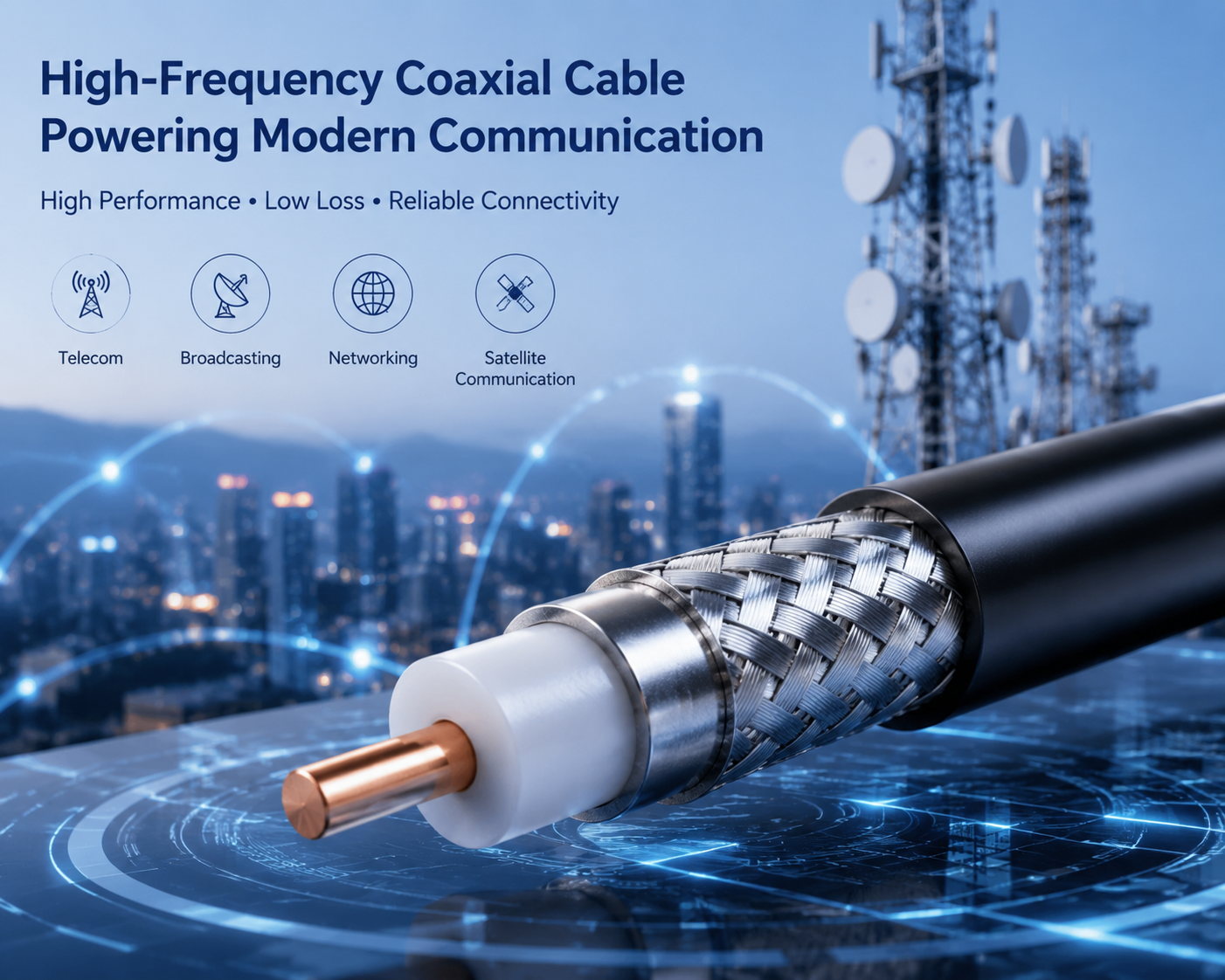
High-frequency coaxial cables typically consist of:
1.Inner conductor: Usually silver-plated or bare copper, ensuring low resistance and high conductivity.
2.Insulation layer: Made from low-dielectric materials like PTFE to minimize signal loss and reflection.
3.Shielding layer: Multi-layer braiding effectively blocks electromagnetic interference.
4.Outer jacket: Protects the cable from mechanical damage and environmental factors.
Compared to standard cables, high-frequency coaxial cables offer low loss, high bandwidth, strong interference resistance, flexibility, and long service life. These features make them ideal for demanding communication environments, whether for indoor wiring or long-distance outdoor transmission, ensuring signal quality remains excellent.
Long-tail keyword suggestions: high-bandwidth cable, low-loss coaxial cable, communication interference-resistant cable.
3.Applications in Communication, Broadcasting, and Networking
High-frequency coaxial cables are widely used in various communication systems, including:
Wireless base stations and mobile communication systems: Connect antennas and RF devices for efficient signal transmission.
Broadcasting and television systems: Transmit high-definition audio and video signals, ensuring clear visuals and stable sound.
Data communication and networking equipment: Connect routers, switches, and antennas for high-speed data transfer.
Satellite communication and radar systems: Ensure reliable and stable long-distance signal transmission.
By using high-frequency coaxial cables, operators and businesses can significantly improve network transmission efficiency while reducing interference and data loss.
4. Installation and Usage Considerations
Although high-frequency coaxial cables offer excellent performance, the following precautions should be observed during installation and usage:
1.Choose the correct cable model according to operating frequency and transmission distance to avoid excessive signal loss.
2.Avoid excessive bending or stretching to prevent structural damage affecting electrical performance.
3.Ensure connectors are of high quality and properly secured to prevent reflection or poor contact.
4.Regularly inspect cables and connectors for aging or damage, replacing components as needed to maintain long-term system stability.
Proper usage maximizes the benefits of high-frequency coaxial cables, ensuring reliable and efficient communication systems.
5.Conclusion: Enhancing Signal Quality with High-Frequency Coaxial Cables
Overall, high-frequency coaxial cables play a vital role in modern communication applications due to their superior electrical performance and reliable structural design. They effectively enhance signal transmission quality, reduce interference and loss, and meet the demands of high-frequency, high-speed, and high-bandwidth communication. With the growth of 5G, IoT, and satellite communication technologies, the applications of high-frequency coaxial cables in communication, broadcasting, networking, and industrial fields will continue to expand. Selecting high-quality coaxial cables and using them correctly provides a strong foundation for stable and efficient communication systems.