Patch Cord: The Essential Solution for High-Speed and Reliable Network Connections
In today’s digital communication environment, stable and efficient network infrastructure is essential for businesses, data centers, telecommunications systems, and smart office networks. Among the many components used in structured cabling systems, Patch Cord products play a critical role in ensuring fast, reliable, and organized connectivity.
Whether used in Ethernet networks, fiber optic communication systems, server rooms, or telecommunications cabinets, patch cords provide flexible and secure connections between networking devices. High-quality patch cords help reduce signal loss, improve transmission stability, and enhance overall network performance.
As demand for high-speed internet, cloud computing, and data-intensive applications continues to increase, selecting the right patch cord has become more important than ever for modern networking systems.
1. What Is a Patch Cord?
A Patch Cord, also known as a patch cable, is a short-length cable used to connect electronic or networking devices within a communication system. Patch cords are commonly used to connect:
- Computers to network switches
- Patch panels to routers
- Servers to data center equipment
- Telecommunications devices
- Audio and video systems
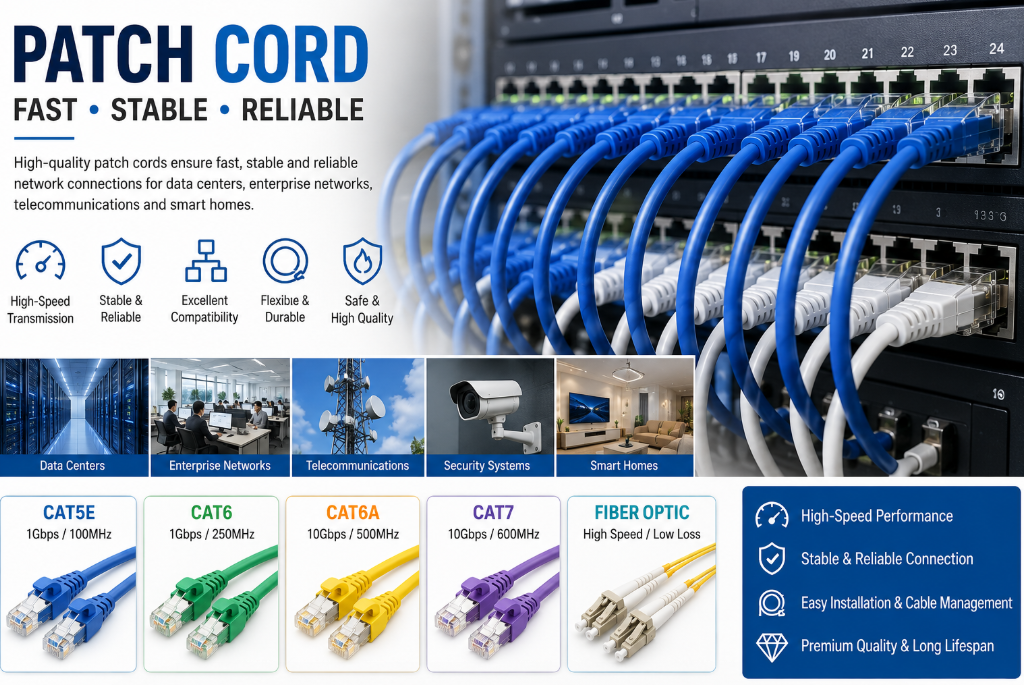
Patch cords are available in multiple cable types, including:
- Ethernet patch cords
- Fiber optic patch cords
- Cat5e patch cords
- Cat6 patch cords
- Cat6A patch cords
- Cat7 patch cords
Each type is designed for specific bandwidth, speed, and transmission requirements.
Patch cords are widely used because they offer easy installation, flexibility, and stable signal transmission in both residential and commercial networking environments.
2. Advantages of High-Quality Patch Cords
Choosing a high-quality patch cord provides several important benefits for network systems and communication infrastructure.
Stable Signal Transmission
Premium patch cords are designed with high-quality conductors and shielding structures that reduce signal interference and transmission loss.
Benefits include:
- Faster network performance
- Stable data transmission
- Reduced packet loss
- Improved communication reliability
Stable signal quality is especially important for high-speed applications such as cloud computing, video conferencing, and online streaming.
High-Speed Data Transfer
Modern patch cords support Gigabit and even 10-Gigabit Ethernet transmission speeds.
For example:
- Cat5e patch cords support up to 1Gbps
- Cat6 patch cords support up to 10Gbps over shorter distances
- Cat6A and Cat7 patch cords provide enhanced bandwidth and reduced crosstalk
These high-speed capabilities make patch cords ideal for enterprise networks and data center environments.
Improved Cable Management
Patch cords help maintain organized and efficient cabling systems inside network cabinets and server rooms.
Well-organized patch cord layouts provide:
- Easier maintenance
- Faster troubleshooting
- Better airflow inside racks
- Reduced cable clutter
Color-coded patch cords are often used for network identification and simplified management.
Strong Durability and Flexibility
High-quality patch cords typically feature durable PVC or LSZH (Low Smoke Zero Halogen) jackets that improve flexibility and cable protection.
Premium patch cords offer:
- Long service life
- Better bending resistance
- Flame-retardant performance
- Reduced risk of physical damage
This is particularly important in high-density network environments.
3. Common Applications of Patch Cords
Patch cords are widely used across various industries and communication systems.
Data Centers
Data centers require high-performance patch cords to support:
- Server connectivity
- High-speed switching systems
- Cloud computing infrastructure
- Large-scale data transmission
Fiber optic patch cords are especially popular in modern data centers due to their ultra-high bandwidth capabilities.
Enterprise Office Networks
Businesses use Ethernet patch cords to connect:
- Desktop computers
- Wireless access points
- Network switches
- IP phones
- Printers and office devices
Reliable patch cords help maintain efficient daily communication and stable internet access.
Telecommunications Systems
Telecom providers rely on patch cords for:
- Signal routing
- Fiber distribution systems
- Communication cabinets
- Broadband network infrastructure
High-quality patch cords improve network stability and long-distance transmission performance.
Smart Home and Security Systems
Patch cords are increasingly used in:
- Smart home automation
- CCTV surveillance systems
- Smart TVs
- Gaming systems
- Home networking setups
Stable network connections are essential for modern connected devices.
4. How to Choose the Right Patch Cord
Selecting the proper patch cord depends on several important factors.
Network Speed Requirements
Users should select patch cords according to their network bandwidth needs.
For example:
- Cat5e for basic Gigabit networking
- Cat6 for high-speed office networks
- Cat6A or Cat7 for data-intensive environments
Higher-category patch cords provide better shielding and future-proof network performance.
Cable Length
Patch cords are available in multiple lengths for different installation environments.
Choosing the appropriate length helps:
- Reduce cable clutter
- Improve airflow
- Maintain organized cable management
Excessively long patch cords may increase signal attenuation in some environments.
Shielding Type
Shielded patch cords provide better protection against electromagnetic interference (EMI).
Common shielding types include:
- UTP (Unshielded Twisted Pair)
- FTP (Foiled Twisted Pair)
- SFTP (Shielded Foiled Twisted Pair)
Industrial or high-interference environments typically require shielded patch cords for stable signal transmission.
5. Conclusion: High-Quality Patch Cords Improve Network Performance
Patch cords are essential components in modern communication and networking systems. From enterprise offices and data centers to telecommunications and smart home applications, high-quality patch cords help ensure stable, fast, and secure data transmission.
When selecting a patch cord, users should consider:
- Network speed requirements
- Cable category
- Shielding structure
- Cable length
- Installation environment
Investing in premium patch cord solutions improves network efficiency, reduces downtime, and supports long-term infrastructure reliability.
As network technologies continue to evolve, high-performance patch cords will remain a key part of future-ready communication systems.
Shenzhen Xunyu Cable Technology Co., Ltd.
Specializing in the production of various high-quality cables, our main products include network cables (Cat5e, Cat6, Cat7), coaxial cables, speaker cables, power cables, patch cords, and more, with OEM customization available.
For product selection guidance or sample testing, please feel free to contact us.
WhatsApp / WeChat:+86 18925240250
How to Choose the Right Cat5e SFTP Outdoor Cable for Reliable Outdoor Networking
Related Article