Ethernet Cable Categories: A Complete Guide to Cat5e, Cat6, Cat6A, and Cat7
Ethernet Cable Categories: A Complete Guide to Cat5e, Cat6, Cat6A, and Cat7
April 2, 2026
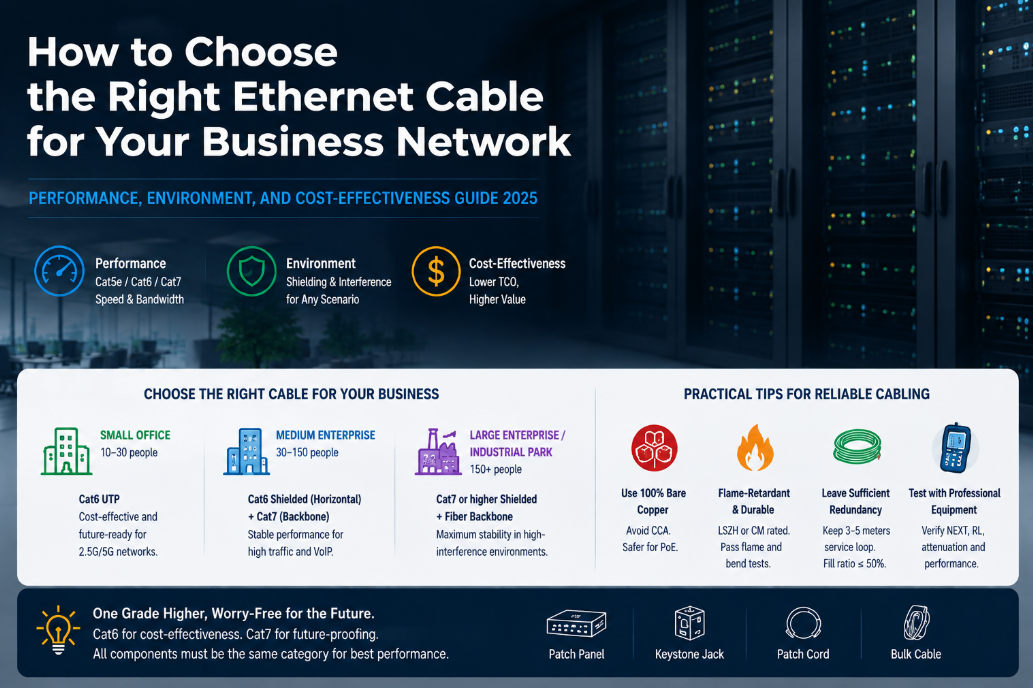
With multiple Ethernet cable categories on the market—from legacy Cat5e to high‑speed Cat7—B2B buyers, integrators, and network planners often struggle to choose the right one. This comprehensive guide explains each category's specifications, real‑world performance, ideal applications, and trade‑offs, so you can specify with confidence.
Comparison at a Glance
| Category | Bandwidth | Max Speed | 10G Distance | Shielding Typical | Standard |
|---|---|---|---|---|---|
| Cat5e | 100 MHz | 1 Gbps | N/A | U/UTP | TIA/EIA-568.2-D |
| Cat6 | 250 MHz | 10 Gbps | 55 m | U/UTP or F/UTP | TIA/EIA-568.2-D |
| Cat6A | 500 MHz | 10 Gbps | 100 m | F/UTP or S/FTP | TIA/EIA-568.2-D |
| Cat7 | 600 MHz | 10 Gbps | 100 m | S/FTP (shielded pairs) | ISO/IEC 11801 (not TIA) |
Cat5e (Category 5 enhanced)
Overview: The most basic still‑common category. Designed for 1 Gbps networks up to 100 meters. Bandwidth is 100 MHz.
- Pros: Lowest cost, widely available, flexible, easy to terminate.
- Cons: Limited to 1 Gbps; cannot support 10 Gbps at any distance. Poor resistance to crosstalk compared to newer categories.
- Best for: Small offices, home networks, temporary installations, or budget‑constrained projects where 1 Gbps is sufficient.
- Note for B2B buyers: Cat5e is being phased out in new commercial builds. Many specifiers now require Cat6 as minimum.
Cat6 (Category 6)
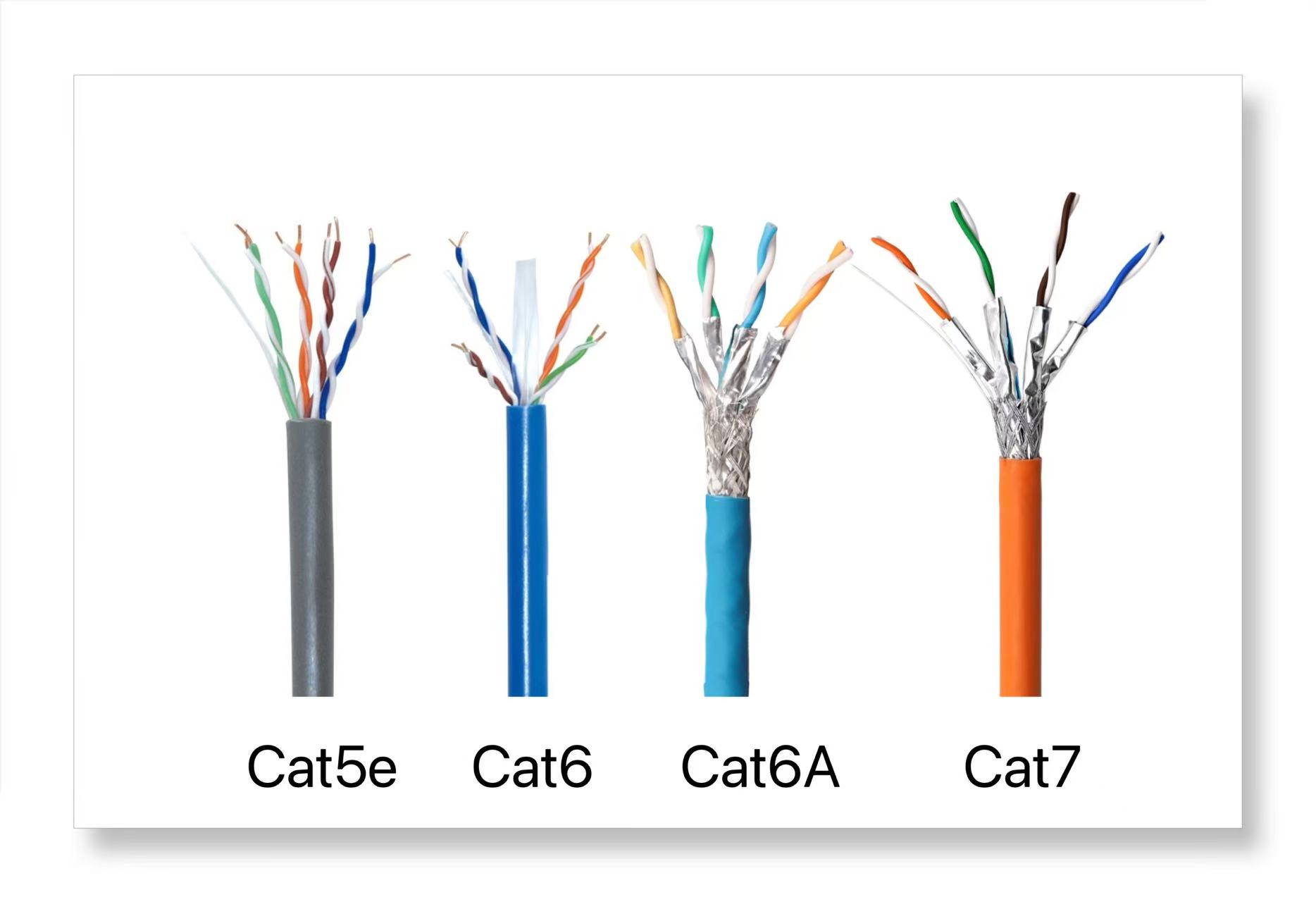
Overview: Supports 10 Gbps up to 55 meters and 1 Gbps to the full 100 meters. Bandwidth is 250 MHz. Often includes a plastic spline (cross filler) to separate pairs and reduce crosstalk.
- Pros: Good balance of cost and performance. Handles 10 Gbps for most equipment room connections. Better PoE performance than Cat5e.
- Cons: 55‑meter limit for 10 Gbps may be insufficient for large buildings. More rigid than Cat5e due to spline.
- Best for: Commercial buildings, schools, healthcare facilities where 10 Gbps runs are under 55 m. Also suitable for most PoE+ (30W) applications.
- B2B tip: Cat6 remains the most popular choice for horizontal cabling in cost‑sensitive projects.
Cat6A (Category 6 augmented)
Overview: Designed to support 10 Gbps over the full 100‑meter channel. Bandwidth doubled to 500 MHz. Improved shielding (usually F/UTP or S/FTP) significantly reduces alien crosstalk.
- Pros: Full 10 Gbps reach, excellent PoE++ support (up to 100W), better heat dissipation, future‑proof for 10+ years. Compatible with all lower categories.
- Cons: Thicker, heavier, less flexible than Cat6. Requires compatible connectors and patch panels. Costs 30–50% more than Cat6.
- Best for: Data centers, university campuses, large office buildings, Wi‑Fi 6E/7 deployments, industrial environments with EMI, and any new installation where 10 Gbps may be needed in the next decade.
- B2B recommendation: For most new commercial projects, Cat6A is the recommended baseline to avoid costly future upgrades.
Cat7 (Category 7)
Overview: A proprietary standard (ISO/IEC 11801 Class F) not recognized by TIA/EIA for Ethernet. Uses S/FTP construction with individually shielded pairs and an overall braid. Bandwidth 600 MHz.
- Pros: Excellent shielding, very low alien crosstalk. Supports 10 Gbps to 100 m.
- Cons: Not a TIA standard; uses non‑standard connectors (GG45 or TERA) to achieve full performance. Backward compatibility with RJ45 is limited. No performance advantage over Cat6A for 10 Gbps.
- Best for: Specialized industrial or high‑EMI environments where proprietary connectors are accepted. Generally not recommended for typical office or data center deployments.
- B2B note: Avoid specifying Cat7 unless a customer explicitly requests it. Cat6A offers the same 10 Gbps performance with standard RJ45 termination.
How to Choose: A Decision Framework
Answer these questions to narrow down the right category for your project:
- What is the required speed today and in 5 years?
– 1 Gbps: Cat5e or Cat6
– 10 Gbps: Cat6 (if ≤55 m) or Cat6A/Cat7 (if >55 m) - What is the maximum link distance?
– Under 55 m: Cat6 can do 10 Gbps
– Over 55 m: Cat6A or Cat7 required for 10 Gbps - Will PoE be used? What power level?
– PoE (15.4W) / PoE+ (30W): Cat6 sufficient
– PoE++ (60W/100W): Cat6A or Cat7 recommended for better heat dissipation - Is the environment high‑EMI (motors, generators, heavy machinery)?
– Yes: Cat6A or Cat7 with proper grounding - What is the total cost of ownership?
– Cat6A offers the best balance for most projects. Cat7 is a niche product for specialized high‑EMI needs.
Common Myths and Misconceptions
- “Higher category always means faster internet.” – No. Your internet speed is limited by your ISP plan. Higher categories support faster local network speeds (e.g., file transfers between servers).
- “Cat7 is better than Cat6A.” – For standard RJ45 Ethernet, Cat6A performs identically (10 Gbps to 100 m) and is easier to terminate. Cat7's extra shielding and bandwidth offer no real‑world benefit in typical networks.
- “You can mix categories freely without penalty.” – The overall link performs at the lowest category in the channel. Mixing Cat6A cable with Cat5e patch panels limits the link to Cat5e performance.
Your Manufacturing Partner
At Shenzhen Xunyu Cable Technology Co.,ltd., we manufacture Cat5e, Cat6, Cat6A, and Cat7 cables to strict quality standards.All products are available with custom printing, packaging, and lengths. We offer multiple shielding options (U/UTP, F/UTP, S/FTP) to match your environmental needs.
Not sure which category fits your next project? Contact our team for a free consultation, product samples, or bulk pricing. We'll help you choose the right cable for performance, budget, and future growth.
WhatsApp / WeChat: +86 18925240250
Published on April 2, 2026 – Expert guidance for reliable networks.
Cat6 vs. Cat6A: When Is the Upgrade Worth the Cost?
Related Article