Cat6 vs Cat7: A Practical Guide to Choosing High-Performance Ethernet Cabling
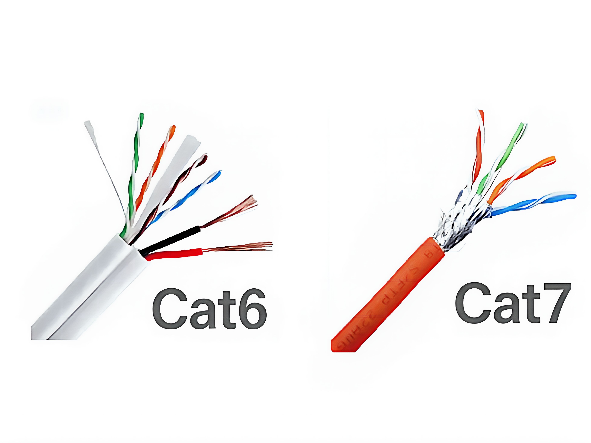
In today’s era of rapid digital transformation, the demand for high-performance Ethernet cables has never been greater—whether for enterprise data centers, smart buildings, or high-end home offices. With the rise of Wi-Fi 6, 8K video streaming, and massive IoT deployments, network bottlenecks are often no longer in the router but hidden inside the walls. When faced with the choice between Cat6 and Cat7, many IT decision-makers and property owners struggle to decide. Should you go with cost-effective, proven Cat6 or future-proof with Cat7? This practical guide will walk you through everything you need to know.
Cat6 vs Cat7: Performance Comparison
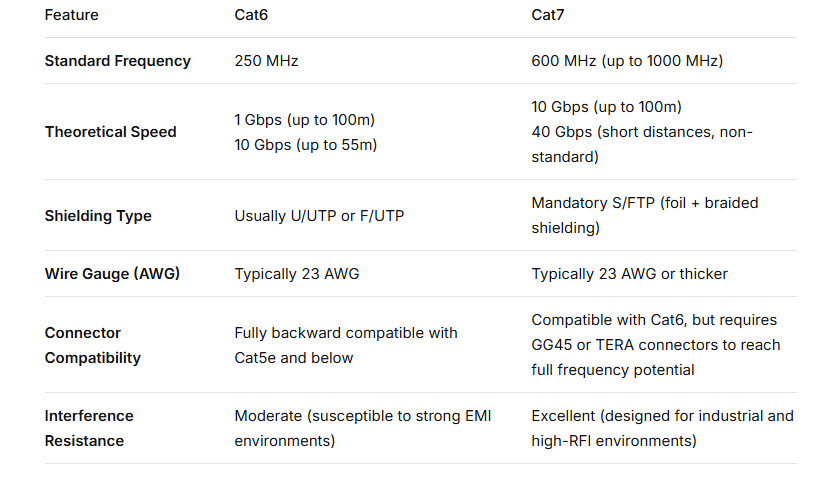
Before diving into use cases, here is a clear table comparing the core technical specifications of these two types of high-performance Ethernet cables:
Recommended Use Cases
Different environments determine which cable best suits your actual needs:
Best use cases for Cat6:
Small to medium business offices: For standard tasks (web browsing, cloud apps, VoIP), the 1 Gbps provided by Cat6 is more than enough.
Home gigabit broadband: Within 55 meters, Cat6 can also support 10 Gbps, making it a cost-effective choice for home NAS users and gamers.
Budget-conscious projects: When deploying large volumes of cabling in environments without severe electromagnetic interference, Cat6 is a reliable and economical workhorse.
Best use cases for Cat7:
Data centers and server rooms: Dense cabling creates significant crosstalk. Cat7’s dual shielding (S/FTP) ensures stable 10 Gbps transmission over long distances with ultra-low signal latency.
Industrial automation and medical imaging: Factory motors, MRI machines, and similar equipment generate strong EMI. Cat6 may suffer packet loss here, while Cat7’s noise immunity is critical to data integrity.
High-end home theater and smart home hubs: If you need to transmit 4K/8K video, control signals, and network data through the same conduit, Cat7’s superior shielding prevents internal crosstalk.
Cost and Value Analysis
Price is often the final deciding factor. Keep in mind that the total cost of Cat7 involves more than just the cable itself:
1.Raw cable cost: Cat6 costs roughly 40–50% as much per meter as Cat7. Cat7’s complex multi-layer shielding (foil + metal braiding) significantly increases copper and manufacturing costs.
2.Accessory and labor cost: This is the most overlooked trap. Standard Cat6 works with ordinary RJ45 plugs. To truly achieve Cat7’s 600 MHz performance, you typically need special GG45 or TERA connectors. These are not only more expensive per unit, but the crimping tools are costly and the installation takes 3–5 times longer than Cat6. If a technician crimps a standard RJ45 plug on a Cat7 cable, it will perform no better than Cat6a.
3.Long-term return:
Cat6: Suitable for a 3–5 year equipment cycle. If you don’t plan to upgrade to 10-gigabit networking within three years, choose Cat6 and reinvest the savings into Wi-Fi 6 switches.
Cat7: A true 10+ year infrastructure investment. Although initial cabling costs are about 30–50% higher, you won’t need to break walls or re-pull cables for the next decade.
Summary and Recommendations
Choose Cat6 if:
Your networking needs are at the 1 Gbps level, your budget is limited, you prefer easy DIY termination with standard RJ45 plugs, or your cable runs exceed 55 meters and you don’t require full 10 Gbps.
Choose Cat7 if:
You are building a “future-proof for 10 years” cabling system, you are in a high-EMI environment (e.g., near elevators or heavy machinery), you need full 10 Gbps over the full 100-meter distance, and you have a professional installation team trained in shielded grounding and GG45/TERA termination.
Pro tip: For most users who want high performance without the installation headaches of Cat7, we recommend looking at Cat6a (Augmented Cat6) . It reliably supports 10 Gbps over 100 meters, reaches 500 MHz, and uses the much more common and easy-to-terminate RJ45 connector. It is often the ideal trade-off between budget and performance.
When choosing high-performance Ethernet cables, don’t blindly chase the highest specification. Realistically evaluate your bandwidth needs, your environmental interference level, and your installation team’s skill set. That’s how you get the most value from every meter of cable.
Shenzhen Xunyu Cable Technology Co., Ltd.
Specializing in the production of various high-quality cables, our main products include network cables (Cat5e, Cat6, Cat7), coaxial cables, speaker cables, power cables, patch cords, and more, with OEM customization available.
For product selection guidance or sample testing, please feel free to contact us.
WhatsApp / WeChat:+86 18925240250
How to Choose High-Quality Coaxial Cables to Ensure Stable Video Surveillance Signals
Cat6 Cable vs Cat5e Upgrade: Essential Choice for High-Speed Networks
Related Article